

North India vs South India: Which Is Better for Your First Trip?
Introduction
When planning your inaugural journey to the subcontinent, the sheer scale of the country can quickly become overwhelming. One of the most common dilemmas travelers face is choosing between North India vs South India. It is a crucial decision, as these two regions offer wildly different landscapes, architectural styles, culinary traditions, and overall travel experiences. India is not a monolith; it is a massive, diverse collection of cultures that often feel like entirely different countries depending on your latitude.
If you are wondering which region is best suited for your first trip, you are in the right place. Should you dive into the majestic Mughal history and bustling bazaars of the North, or would you prefer the laid-back, tropical serenity and ancient Dravidian temples of the South? In this comprehensive 2026 guide, we will break down the core differences, highlight the best destinations in each region, and provide expert practical tips to help beginners, families, and professionals craft the perfect itinerary for an unforgettable Indian adventure.
Understanding the Core Difference Between North and South India
Before diving into specific itineraries, it helps to understand why the North and South feel so distinctly different. The dividing line is roughly formed by the Vindhya Mountain range and the Narmada River in central India, creating a natural boundary that has historically shaped the evolution of the two regions.
Geography and Climate
Geography dictates the travel experience. The North is defined by vast plains, arid deserts in the west, and the towering, snow-capped Himalayas in the north. The climate experiences extreme fluctuations: blistering hot summers and notably cold winters.
Conversely, the South is a peninsula flanked by the Arabian Sea and the Bay of Bengal, tapering down into the Indian Ocean. Its geography is dominated by lush tropical coastlines, the rolling hills of the Western Ghats, and dense rainforests. Because it sits closer to the equator, the South maintains a warm, humid, tropical climate year-round, governed heavily by the monsoon rains.
Language, Culture, and Vibe
Language is a profound differentiator. In the North, Hindi is the dominant lingua franca, alongside regional languages like Punjabi and Rajasthani. The culture is heavily influenced by centuries of Central Asian and Mughal rule, resulting in grand, imposing architecture and a fast-paced, high-energy environment.
The South, however, speaks Dravidian languages—such as Tamil, Malayalam, Kannada, and Telugu—which have no linguistic connection to Hindi. Because the South was largely shielded from northern invasions, its ancient Hindu traditions, classical arts, and towering temple architecture have remained remarkably preserved. The general “vibe” in the South is frequently described by travelers as more relaxed, slower-paced, and gentler on the senses.
The Allure of North India: Monuments, Mountains, and Mysticism
For many first-time visitors, North India represents the quintessential Indian experience they have seen in movies and magazines. It is loud, vibrant, deeply historic, and incredibly photogenic. Here is what makes the North Indian travel circuits so captivating.
The Golden Triangle and Spiritual Hubs
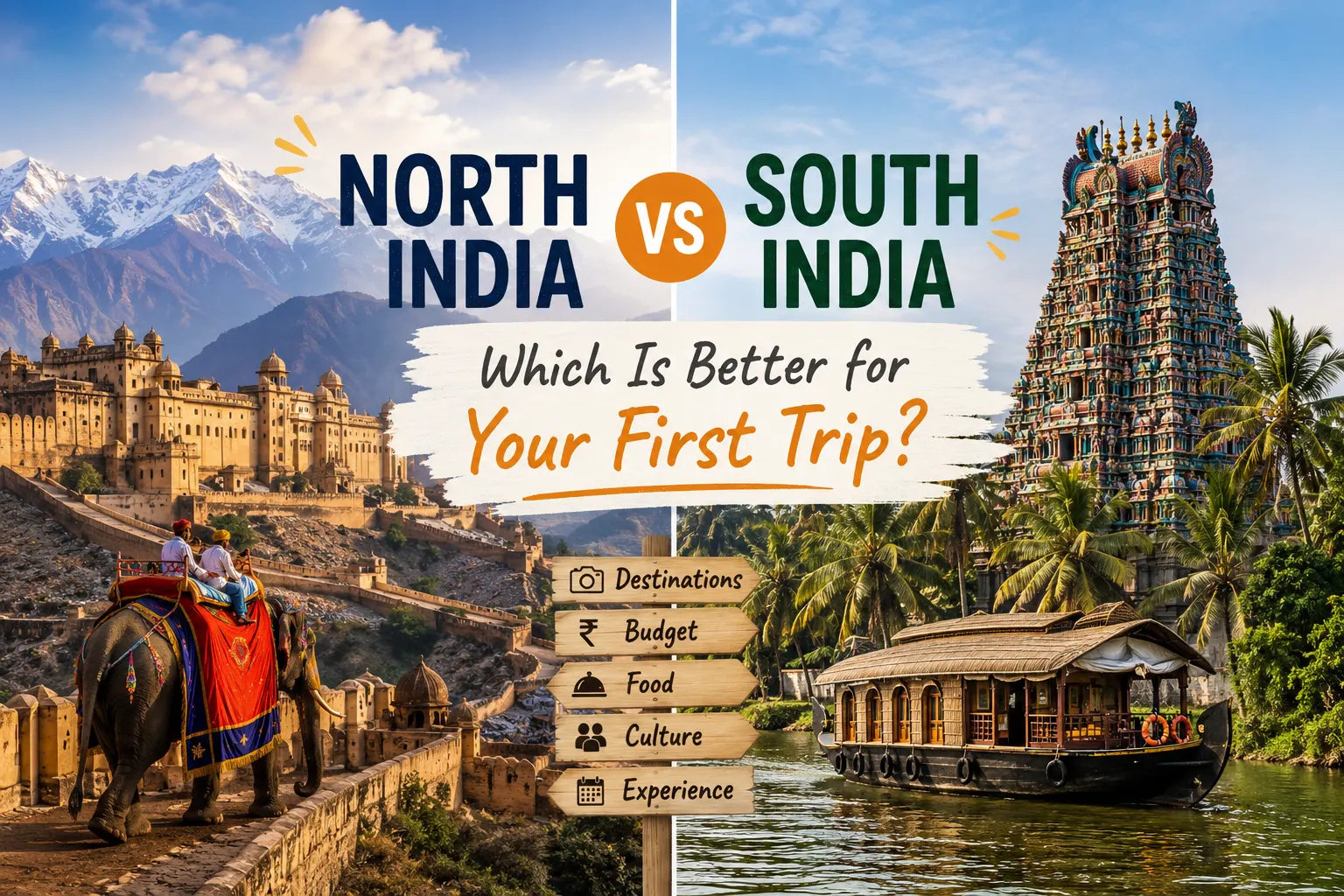
The undisputed heavyweight champion of Indian tourism is the Golden Triangle, connecting Delhi, Agra, and Jaipur. This route offers a seamless, well-trodden path for beginners to witness the Taj Mahal, the sprawling Red Fort, and the opulent palaces of Rajasthan.
For those seeking cultural depth, North India is the epicenter of spiritual tourism. Expanding your circuit just a few hours outside the Golden Triangle allows you to explore the sacred twin cities of Mathura and Vrindavan, the birthplace of Lord Krishna. Further east, the ancient, labyrinthine alleyways of Varanasi and the newly developed spiritual corridors of Ayodhya offer an intense, unfiltered immersion into Hindu devotion along the holy rivers.
Royal Rajasthan and Wildlife Safaris
If you want to experience India like royalty, the desert state of Rajasthan is unparalleled. Cities like Udaipur (the City of Lakes) and Jodhpur (the Blue City) offer magnificent heritage hotels converted from actual palaces. Beyond the architecture, the North is prime territory for wildlife enthusiasts. Adding an 8-day Rajasthan wildlife tour to your itinerary allows you to visit Ranthambore National Park, one of the premier locations on earth to spot the elusive Bengal tiger in the wild.
Himalayan Escapes: Shimla, Manali, and Ladakh
If the heat of the plains seems daunting, North India offers breathtaking high-altitude retreats. Traditional hill stations like Shimla and Manali provide comfortable, family-friendly mountain escapes surrounded by pine forests and colonial architecture. For the more adventurous traveler, the remote, high-altitude desert of Leh Ladakh—often combined with the lush valleys of Kashmir—offers pristine, crystal-clear lakes, ancient Buddhist monasteries, and some of the safest, most peaceful environments in the entire country.
The Charm of South India: Backwaters, Temples, and Tranquility
If North India is an exhilarating sensory overload, South India is a soothing balm. It is green, deeply traditional, and relatively free from the aggressive touting that can sometimes fatigue tourists in the North.
Kerala’s Backwaters and Beaches
Kerala, famously dubbed “God’s Own Country,” is the jewel of the South. For a first trip, renting a traditional thatched-roof houseboat and floating through the serene, palm-fringed backwaters of Alleppey is a mandatory experience. It is profoundly peaceful. The state also boasts beautiful, safe beaches like Marari and Varkala, alongside world-renowned Ayurvedic wellness retreats perfect for professionals looking to unplug and detox.
The Ancient Temples of Tamil Nadu
While the North has the Taj Mahal, the South has staggering, ancient Dravidian temple complexes. In Tamil Nadu, cities like Madurai, Thanjavur, and Mahabalipuram showcase towering, brightly painted gopurams (gateway towers) that date back thousands of years. The spiritual atmosphere here feels older and more localized. Pondicherry, a former French colony bordering Tamil Nadu, offers a charming fusion of Indian culture and European coastal town aesthetics.
Lush Hill Stations of the Western Ghats
You don’t need the Himalayas to find altitude in India. The Western Ghats run down the spine of the South, offering stunning, misty hill stations. Munnar in Kerala is famous for its endless, manicured tea plantations, while Coorg in Karnataka is a haven for coffee lovers and spice-farm tours. These regions are incredibly safe, pristine, and perfect for gentle trekking.
Comparing the Culinary Landscapes
To truly debate North India vs South India, you must look at the dinner plate. The culinary divide is as distinct as the geographical one.
North Indian Cuisine: Rich Curries and Breads
If you have eaten at an “Indian restaurant” in the US or UK, you have likely experienced North Indian food. It is characterized by thick, creamy, tomato-and-onion-based gravies (like Butter Chicken or Rogan Josh) and an extensive reliance on dairy (paneer, ghee, and yogurt). Because wheat grows abundantly in the North, meals are accompanied by a massive variety of flatbreads, including naan, roti, and paratha, baked in clay tandoor ovens.
South Indian Cuisine: Rice, Coconut, and Spices
South Indian food is generally lighter, tangier, and heavily reliant on the coastal abundance of coconuts, tamarind, and seafood. Rice is the staple grain. Instead of heavy breads, you will find incredibly flavorful rice-based creations like the iconic dosa (a thin, crispy crepe), idli (steamed rice cakes), and vada (savory donuts), typically served with coconut chutney and a spicy lentil stew called sambar. Meals are often traditionally served on fresh banana leaves.
Practical Tips: Choosing the Right Vibe for You
So, which region should you choose for your first trip to India? The answer lies in your travel style, your tolerance for chaos, and the time of year you plan to visit.
Travel Pace and Sensory Experience
- Choose North India if: You want the iconic “bucket list” photos (Taj Mahal, Rajasthan forts), love high-energy environments, want to experience intense spirituality (Varanasi, Mathura), or desire to explore the snow-capped Himalayas. It requires a thicker skin and more patience, but it delivers massive, jaw-dropping rewards.
- Choose South India if: You prefer a slower, more relaxing vacation, want to focus on wellness and nature, love tropical climates, or are traveling with young children who might be overwhelmed by the chaos of northern mega-cities. It is an excellent “soft landing” for beginners.
Best Time to Visit Each Region
- When to visit the North: The plains of North India are best visited during the winter, from October to March, when the weather is cool and dry. Avoid the plains in May and June due to extreme heat, though this is the perfect time to visit mountain destinations like Leh Ladakh, Shimla, and Manali.
- When to visit the South: The South is also best from November to February, avoiding the intense humidity of the summer. However, if you love the dramatic beauty of the monsoon and want to undergo Ayurvedic treatments (which are considered most effective during the rains), July and August in Kerala are uniquely magical.
Conclusion: Making the Final Decision
The debate of North India vs South India has no wrong answer; it only has the right answer for you. If you crave the epic historical narratives, the sensory thrill of crowded bazaars, and the architectural grandeur of the Mughals and Rajputs, the North Indian travel circuits will leave you breathless. If you are seeking tropical tranquility, ancient spiritual traditions untouched by time, and a gentle immersion into local life, the South will welcome you with open arms.
Ultimately, India is a country that requires multiple visits to truly comprehend. Whichever half you choose for your inaugural journey, you are guaranteed a vibrant, life-changing experience. Embrace the differences, pack an open mind, and get ready for the adventure of a lifetime.
Ready to start building your dream itinerary? If the majestic North is calling your name, check out our guide to Navigating North Indian Travel Circuits: A Beginner’s Guide, or if the tropics have won you over, dive into A Beginner’s Guide to Exploring the Kerala Backwaters. Subscribe to our newsletter today for more expert travel insights!
Frequently Asked Questions (FAQs)
Q.1 Is South India safer than North India for tourists?
Generally speaking, South India (particularly Kerala) is often perceived as “safer” or, more accurately, less intense. The instances of aggressive touts and common tourist scams are notably lower in the South compared to the heavily trafficked Golden Triangle in the North. However, both regions are safe for first-timers who exercise standard travel precautions.
Q.2 Which region is cheaper to travel in?
Both regions accommodate all budgets, from $15/night backpacker hostels to $1,000/night royal palaces. However, the everyday cost of local transport, street food, and budget accommodation tends to be slightly cheaper in the South.
Q.3 Do I need to speak Hindi to travel in South India?
No. In fact, attempting to speak Hindi in states like Tamil Nadu may not be well-received, as locals are fiercely proud of their Dravidian languages. English is widely spoken and understood across both North and South India, particularly in tourist hubs, hotels, and restaurants.
Q.4 Can I combine North and South India in one trip?
If you have three weeks or more, absolutely. A popular 3-week itinerary involves doing the Golden Triangle and Rajasthan for the first two weeks, and then catching a quick 2.5-hour domestic flight down to Kochi (Kerala) to unwind in the backwaters for the final week. If you only have 10-14 days, stick to one region to avoid travel burnout.
Q.5 Which region has better transportation for tourists?
Both regions are incredibly well-connected by domestic airlines and the Indian Railway network. The North features the high-speed Vande Bharat trains connecting major tourist hubs very efficiently. The South has excellent, scenic train routes and well-maintained state highways perfect for hiring a private driver.