

The Ultimate Best 7-Day India Itinerary for First-Time Travelers in 2026
Introduction
Embarking on a journey to the Indian subcontinent is a thrilling, transformative experience. However, the sheer size and bustling energy of the country can make planning feel like a monumental task. If you are wondering how to capture the magic of this vast nation in just a single week, you are in the right place. Crafting the best 7-day India itinerary for first-time travelers** requires a strategic balance between seeing world-renowned monuments and allowing yourself enough time to absorb the profound cultural shifts without succumbing to travel burnout.
For beginners, professionals taking a quick cultural retreat, and families seeking a safe, structured holiday, the definitive answer is the classic Golden Triangle. Connecting the historic capital of Delhi, the romantic city of Agra, and the royal splendor of Jaipur, this North Indian travel circuit provides a flawless, logistically smooth introduction to the country. In 2026, with the introduction of high-speed rail networks and seamless digital payment systems, navigating this route is safer and more comfortable than ever. In this comprehensive guide, we will break down exactly how to spend your 1 week in India itinerary, offering a day-by-day roadmap, practical safety tips, and expert insights to ensure your inaugural adventure is absolutely unforgettable.
Why the Golden Triangle is the Perfect 1 Week in India Itinerary
When you only have seven days, efficiency is your most valuable asset. The Golden Triangle is universally recognized as the optimal starting point for several critical reasons.
First, the tourism infrastructure here is world-class. You will find an abundance of heritage hotels, English-speaking guides, and dedicated tourist police to ensure a secure environment. Second, the geographical proximity of Delhi, Agra, and Jaipur (forming an equilateral triangle of roughly 200-250 kilometers apart) means you will not waste precious vacation days stuck in transit. Finally, this specific circuit offers an incredible cross-section of Indian history. You will witness the layered empires of Delhi, the pinnacle of Mughal architecture in Agra, and the fierce, colorful Rajput heritage in Rajasthan—all within a span of 168 hours.
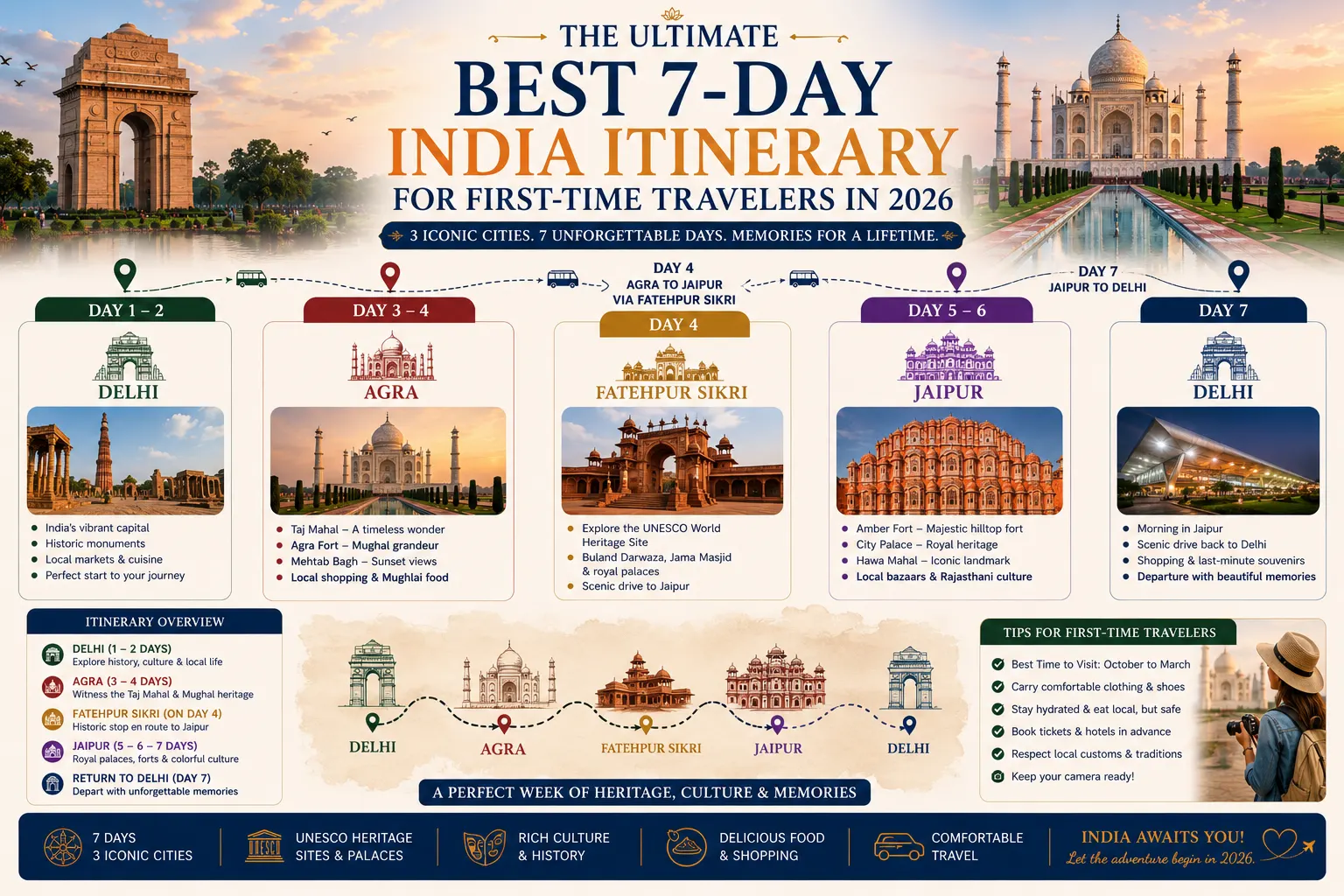
Day-by-Day Breakdown: Best 7-Day India Itinerary for First-Time Travelers
To maximize your time, this itinerary assumes you are arriving at Indira Gandhi International Airport (DEL) in New Delhi on Day 1.
Day 1: Arrival in New Delhi – The Historic Capital
Your first day in India is all about a soft landing. International flights often arrive late at night or early in the morning. Proceed through the e-Visa and immigration counters, collect your baggage, and use a verified ride-sharing app like Uber or BluSmart to reach your hotel.
* Morning/Afternoon: Focus entirely on acclimatization. Check into a comfortable hotel in South Delhi or Central Delhi (such as Connaught Place). Rest and recover from jet lag.
* Evening: Ease into the culture with a gentle stroll through the beautifully manicured Lodhi Gardens, a peaceful park dotted with 15th-century tombs. Follow this with a welcome dinner at a highly-rated, tourist-friendly restaurant offering mild North Indian cuisine, allowing your stomach to adjust to the new spices.
Day 2: Exploring Old and New Delhi
Delhi is a fascinating tale of two cities, perfectly juxtaposing the ancient and the modern.
* Morning: Start your day early with a guided tour of Old Delhi. Ride a traditional cycle-rickshaw through the narrow, chaotic, and vibrant lanes of Chandni Chowk. Visit the Jama Masjid, one of the largest mosques in India, and witness the imposing red sandstone walls of the Red Fort from the outside.
* Afternoon: Transition to the broad, tree-lined avenues of New Delhi, designed by British architect Edwin Lutyens. Visit India Gate, the Parliament House, and the spectacular Humayun’s Tomb. This UNESCO World Heritage site is widely considered the architectural precursor to the Taj Mahal and is a must-see for history enthusiasts.
* Evening: Visit the Qutub Minar complex just before sunset. The towering, 73-meter-tall brick minaret looks breathtaking bathed in the evening light. Enjoy dinner at an upscale restaurant in the trendy Hauz Khas Village.
Day 3: Journey to Agra and the Magnificent Taj Mahal
It is time to leave the capital and head to the most famous monument on the subcontinent.
* Morning: Take the high-speed Vande Bharat Express train from Delhi to Agra. The journey takes under two hours and is incredibly clean and comfortable. Upon arrival, check into your hotel and freshen up.
* Afternoon: Visit the incredible Agra Fort. Often overshadowed by the Taj Mahal, this massive red sandstone fortress was the main residence of the emperors of the Mughal Dynasty until 1638. Exploring its courtyards and audience halls provides deep context for the region’s history.
* Evening: Head to Mehtab Bagh (the Moonlight Garden) located across the Yamuna River. This Park aligns perfectly with the Taj Mahal and offers a stunning, quiet, and crowd-free vantage point to watch the sunset over the monument’s white marble dome.
Day 4: The Taj Mahal, Fatehpur Sikri, and the Drive to Jaipur
This is arguably the most visually spectacular day of your entire best 7-day India itinerary for first-time travelers.
* Early Morning: Wake up before dawn for a sunrise Taj Mahal tour. This is non-negotiable. Arriving right as the gates open ensures you beat the intense midday heat and the massive crowds, allowing you to capture pristine photographs as the rising sun paints the marble in hues of pink and gold.
* Late Morning: Return to your hotel for a hearty breakfast, check out, and hire a private, air-conditioned car with a driver for the journey to Jaipur (roughly a 4 to 5-hour drive).
* Afternoon: Break up the drive by stopping at Fatehpur Sikri, located about an hour outside of Agra. This impeccably preserved, deserted royal city was built by Emperor Akbar in the 16th century and abandoned shortly after due to a lack of water. It is an architectural masterpiece.
* Evening: Arrive in Jaipur, the famed Pink City, in the late afternoon. Check into a traditional Rajasthani heritage hotel—many of which are converted royal residences—and enjoy a quiet, relaxing dinner.
Day 5: Discovering the Pink City of Jaipur
Jaipur is the vibrant, colorful heart of Rajasthan, famous for its gemstones, textiles, and royal architecture.
* Morning: Begin at the City Palace, a sprawling complex of courtyards, gardens, and museums still partially occupied by the Jaipur royal family. Next door, visit the Jantar Mantar, an incredible 18th-century astronomical observatory featuring the world’s largest stone sundial.
* Afternoon: Head to the iconic Hawa Mahal (Palace of Winds). You do not need to go inside; the best view of this stunning, honeycombed pink façade is from the rooftop cafes directly across the street. Spend the rest of the afternoon shopping in the bustling Johari Bazaar and Bapu Bazaar, picking up pure cotton textiles, block-printed fabrics, and traditional handicrafts.
* Evening: For a cinematic experience, catch a Bollywood movie at the legendary Raj Mandir Cinema. Even if you do not understand Hindi, the energy of the crowd and the sheer opulence of the theater make it a highly entertaining evening.
Day 6: Amber Fort and Rajasthani Heritage
Your final full day in Rajasthan involves exploring the rugged hills surrounding Jaipur.
* Morning: Drive just outside the city to the majestic Amber Fort (Amer Fort). Perched on a hilltop overlooking Maota Lake, this fort is a breathtaking blend of Hindu and Mughal architecture. Walk up the cobbled paths (avoiding the elephant rides for ethical reasons) and explore the Sheesh Mahal (Mirror Palace), where thousands of tiny mirrors reflect a single beam of light to illuminate the entire room.
* Afternoon: On your way back to the city, stop for a photo op at the Jal Mahal, a beautiful palace that appears to be floating in the center of Man Sagar Lake. Use the rest of your afternoon to relax by your hotel pool or indulge in an Ayurvedic massage to soothe your travel-weary muscles.
* Evening: Conclude your Rajasthan experience with an authentic Thali dinner. A Thali is a massive silver platter featuring small bowls of various regional curries, lentils, breads, and desserts, offering a complete explosion of Rajasthani flavors.
Day 7: Return to Delhi – Departure
The final day of your 1 week in India itinerary involves wrapping up loose ends and preparing for your journey home.
* Morning: Enjoy a leisurely breakfast in Jaipur. You can choose to take a quick, 45-minute domestic flight back to New Delhi, or ride the comfortable Vande Bharat Express train (approximately 4 hours).
* Afternoon: Once back in Delhi, if you have a late-night international flight, you can safely store your luggage at the airport or a transit hotel. Spend your final hours picking up last-minute souvenirs at Dilli Haat, an open-air food plaza and craft bazaar that features artisans from every state in India in a clean, regulated environment.
* Evening: Head to Indira Gandhi International Airport, deeply enriched by the history, colors, and chaos of your first successful Indian adventure.
Enhancing Your Trip: Adding Mathura and Vrindavan
If you are a fast-paced traveler and want to squeeze even more cultural depth into your best 7-day India itinerary for first-time travelers, consider making a pit stop between Delhi and Agra.
The Spiritual Heart of North India
Located just an hour before Agra, the twin cities of Mathura and Vrindavan are revered as the birthplace and childhood home of Lord Krishna. Adding a quick half-day tour here offers a profoundly different experience than the monumental architecture of the Golden Triangle. It provides a raw, unfiltered look at Hindu devotion. You can visit the Prem Mandir or the ISKCON temple, immersing yourself in the vibrant chanting, colorful flower markets, and deep spiritual energy that defines the North Indian travel circuits.
Essential Practical Tips for Your 7-Day Journey
Executing this itinerary flawlessly requires a bit of practical preparation. Here are the crucial tips for ensuring your safety and comfort in 2026.
Digital Payments and UPI for Tourists
India is now a virtually cashless society. The Unified Payments Interface (UPI) allows you to pay for everything—from high-end restaurant meals to roadside souvenirs—using your smartphone. Before you arrive, download a tourist-friendly UPI app that links to your international credit card or phone number. This prevents you from having to carry large amounts of cash, eliminates the hassle of haggling over change, and significantly reduces the risk of pickpocketing.
Navigating Safe Transportation
When traversing the Golden Triangle, avoid hailing unmetered street taxis or auto-rickshaws, especially at night. Rely exclusively on GPS-tracked ride-sharing apps like Uber, Ola, or BluSmart for inner-city travel. For intercity travel, pre-book your train tickets on the AC chair car classes (CC or EC) via the official IRCTC portal, or hire a private driver through a reputable, verified travel agency.
Health and Hydration Rules
To avoid the infamous “Delhi Belly,” adhere strictly to a few dietary rules. Never drink tap water; only consume sealed, bottled mineral water (like Kinley or Bisleri) and use it to brush your teeth. Avoid raw salads, peeled fruit, and ice in your drinks unless you are dining in a 5-star hotel. Eat where the locals eat, ensuring the food is cooked fresh and served piping hot.
Conclusion: Making the Most of Your Best 7-Day India Itinerary for First-Time Travelers
India is a destination that demands to be felt just as much as it is seen. It is loud, vibrant, deeply historic, and profoundly beautiful. By following this best 7-day India itinerary for first-time travelers, you are guaranteeing yourself a secure, highly organized, and deeply enriching introduction to the subcontinent.
From the bustling, aromatic lanes of Old Delhi and the ethereal, silent beauty of the Taj Mahal at dawn, to the regal, pink-hued palaces of Jaipur, the Golden Triangle delivers a masterclass in global history. Remember to pace yourself, stay hydrated, utilize modern digital payment tools, and approach every interaction with an open mind and a sense of wonder.
Ready to start packing your bags? Ensure you are fully prepared by reading our comprehensive guide on What to Wear in India: A Packing Guide for Women, or dive deeper into regional transit with *Navigating North Indian Travel Circuits: A Beginner’s Guide*. Subscribe to our newsletter today to receive the latest travel updates and expert itineraries directly to your inbox!
Frequently Asked Questions (FAQs)
Q.1 Is 7 days enough for a first trip to India?
Yes, 7 days is perfectly sufficient if you focus your energy on a specific region. The Golden Triangle is specifically designed to be completed in one week, offering a dense, highly rewarding concentration of history and culture without requiring exhausting cross-country flights.
Q.2 Are the North Indian travel circuits safe for solo female travelers?
Yes, the Golden Triangle is one of the safest places to visit in India for solo females, provided standard precautions are taken. Dress modestly (covering shoulders and knees), avoid wandering alone in unlit areas at night, and use verified transportation apps.
Q.3 What is the best time of year to do this 7-day India itinerary?
The optimal time to travel the Golden Triangle is during the winter months, from October to March. The weather is cool, dry, and highly pleasant for outdoor sightseeing. Avoid May and June, as temperatures routinely soar above 105°F (40°C).
Q.4 Do I need a visa for a 1-week trip to India?
Yes, most international tourists (including US, UK, and EU citizens) require a visa to enter India. Fortunately, you can easily apply for a 30-day e-Tourist visa online a few weeks prior to your departure, eliminating the need to visit an embassy.
Q.5 How much spending money do I need for a week in India?
Excluding hotels and flights, a comfortable mid-range budget for food, monument entry fees, local transport, and light shopping is around $50 to $80 USD per day. Luxury travelers can expect to spend upwards of $150+ USD per day on fine dining and private drivers.