
The Ultimate India Visa Guide for US Citizens (Updated 2026)
Introduction
Are you an American traveler dreaming of exploring the magnificent Taj Mahal, doing lucrative business in Bangalore’s tech hubs, or enjoying a serene wellness retreat in the backwaters of Kerala? Navigating international travel bureaucracy can often feel daunting, but our comprehensive India visa guide for US citizens is here to completely simplify the process.
In 2026, the Indian government introduced sweeping digital upgrades, making it easier than ever for Americans to apply for their travel authorizations online. However, with new systems taking effect—such as the mandatory Electronic Arrival Form and updated processing protocols—staying informed is absolutely critical to avoid airport delays. This guide provides an in-depth, step-by-step look at everything you need to know about securing your visa, gathering your documents, and arriving seamlessly. Whether you are a solo backpacker or a traveling executive, let’s dive into the ultimate roadmap for your upcoming journey to the vibrant Indian subcontinent.
Overview of India Visa Options for US Passports
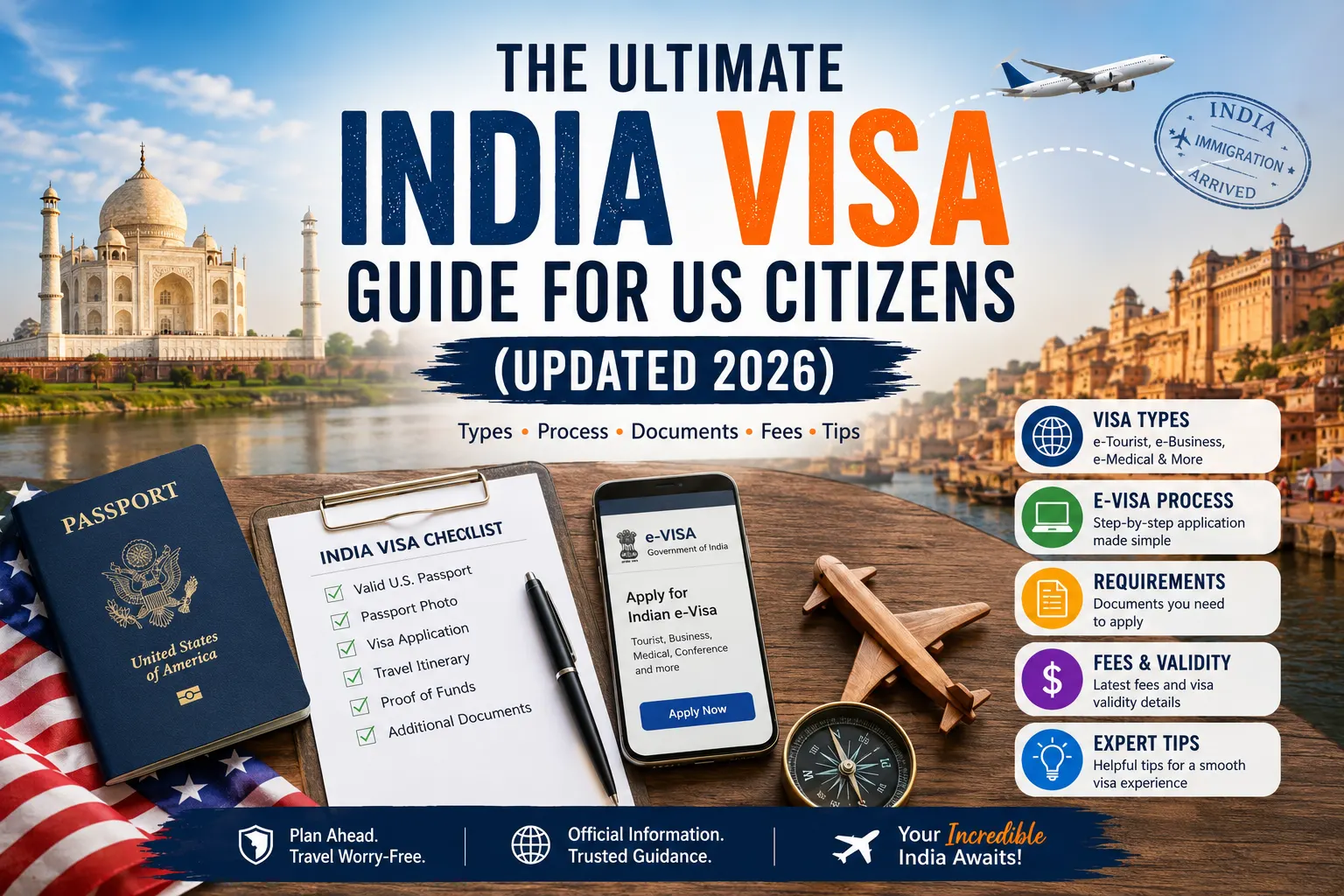
Before you can pack your bags, you need to determine which visa category aligns with the purpose of your trip. The Indian government has fully digitized most of its visa services, allowing Americans to apply for an Electronic Travel Authorization (ETA) without ever visiting an embassy. Here are the primary e-Visa categories available to US citizens.
The e-Tourist Visa
The most popular option for leisure travelers, the e-Tourist visa, is designed for recreation, sightseeing, and casual visits with friends or relatives.The Indian government offers three distinct durations for American tourists:
- 30-Day e-Tourist Visa: This allows for a double entry into India and is valid for 30 days from the date of your first arrival. It is perfect for short vacations.
- 1-Year e-Tourist Visa: This grants multiple entries over a 365-day period. However, each continuous stay cannot exceed 180 days.
- 5-Year e-Tourist Visa: Ideal for frequent travelers, this visa grants multiple entries over five years. Like the 1-year visa, you can only stay for a maximum of 180 days consecutively during each visit.
The e-Business Visa
If you are a professional traveling for meetings, establishing industrial ventures, conducting tours, or delivering lectures, the e-Business Visa is your go-to option. This visa is valid for one year from the date of grant and allows multiple entries. As a US citizen, you can stay up to 180 days continuously without needing to register with the Foreigners Regional Registration Officer (FRRO). If your business requires a stay longer than 180 days, FRRO registration becomes mandatory within two weeks of crossing the 180-day mark.
e-Medical and e-Conference Visas
India is a premier destination for both international conferences and world-class medical treatments.
- e-Medical Visa: Valid for 60 days from the date of first arrival, allowing triple entry. You will need a letter from a recognized and specialized hospital in India to qualify. Up to two e-Medical Attendant visas can be granted to family members accompanying the patient.
- e-Conference Visa: Valid for 30 days with a single entry, this is specifically for attending workshops or seminars organized by Indian government ministries, PSUs, or recognized educational institutions.
Indian e-Visa Application Process 2026: Step-by-Step
Navigating the Indian visa application process 2026 is straightforward if you know what to expect. The entire process is conducted online, meaning no mailing away your physical passport.
Step 1: Prepare Your Required Documents
Before opening the application portal, gather your digital files. You will need a clear, scanned color copy of the biographical page of your US passport in PDF format (maximum size 300 KB). Additionally, you need a recent passport-style photograph in JPEG format. The photo must be square, have a plain white background, and clearly show your face without glasses or heavy shadows. If you are applying for a business or medical visa, ensure you also have your supporting documents (like a business card, invitation letter, or hospital letter) ready in PDF format.
Step 2: Complete the Official Online Application
Always ensure you are using the official government website (indianvisaonline.gov.in). Beware of third-party agencies that charge exorbitant markups for this simple process. The application form will ask for detailed personal information, including your parents’ birthplaces, your visible identification marks, and your religion. It will also require you to list the countries you have visited in the last ten years. Take your time and double-check every field; a simple typo in your passport number will result in an immediate rejection and forfeiture of your fee.
Step 3: Pay the Fee and Await Your Approval
Once the application is submitted, you will be directed to a payment gateway. The fee varies depending on the visa type (e.g., the 5-year tourist visa generally costs around $80 USD, while the 30-day visa drops to $10-$25 depending on the season). You can pay via credit card, debit card, or PayPal. Payment gateways can sometimes time out; if this happens, wait a few hours before attempting to pay again to avoid duplicate charges. Once paid, the processing time is typically 72 hours, though many US citizens receive their approval via email within 24 hours.
New for 2026: The Electronic Arrival Form (Su-Swagatam)
A major update to India travels requirements this year is the complete phasing out of the traditional paper arrival cards handed out on airplanes. The Indian government has fully digitized immigration clearance to reduce airport queues.
How the Digital Arrival System Works
US citizens must now submit the Electronic Arrival Form India via the official government portal or the “Su-Swagatam” mobile app. This must be completed within 72 hours before your arrival in India. The form requires your basic flight details, passport information, and your intended address in India (such as your first hotel). There is no fee to submit this form. Once completed, you will receive a QR code on your mobile device. When you land at major airports like Indira Gandhi International (DEL) or Chhatrapati Shivaji Maharaj International (BOM), you simply scan this QR code at the immigration e-gates, show your approved ETA, and you are cleared to enter.
Key India Travel Requirements & Restrictions
Even with an approved visa, you must adhere to strict immigration policies to ensure you are granted entry at the border.
Passport Validity and Blank Page Rules
Your US passport must be valid for at least six months from your date of arrival in India. If your passport is set to expire in four months, your e-Visa will not be valid, and airlines will deny you boarding in the United States. Furthermore, your passport must contain at least two completely blank pages. Indian immigration officers require these blank pages to physically stamp your entry and exit dates, even though the visa itself is electronic.
Maximum Stay Restrictions
While you may hold a 1-year or 5-year multiple-entry visa, there is a hard limit on how long you can stay in the country. The maximum cumulative stay for a foreigner in India on an e-Tourist visa is restricted to 180 days within a single calendar year. If you attempt to stay longer, you will face hefty overstay fines at the airport upon departure and risk being banned from re-entering the country in the future.
Practical Tips for a Seamless Visa Experience
Applying for a visa is only half the battle; ensuring your journey is smooth requires a bit of insider knowledge.
Avoiding Common Rejection Reasons
The most common reason for an e-Visa rejection is poor document uploads. If your passport scan cuts off the machine-readable zone at the bottom, or if your photograph is blurry or taken against a busy background, the system will reject it. Always use a proper scanner or a high-quality document-scanning app on your smartphone.
Another crucial tip: Always print a physical copy of your approved Electronic Travel Authorization (ETA) that says “GRANTED.” Do not rely solely on pulling it up on your phone at the airport. You must present this physical printout to the airline check-in counter in the US, and again to the immigration officer in India. Keep it tucked inside your passport for the duration of your trip.
Conclusion: Final Thoughts on the India Visa Guide for US Citizens
Securing your travel documents doesn’t have to be a stressful hurdle. By thoroughly understanding the nuances of the e-Tourist, e-Business, and e-Medical options, you can choose the right pathway for your specific journey. Remember that preparation is your best asset. Ensure your passport has the requisite six months of validity and two blank pages, take a crystal-clear photograph, and don’t forget to submit the new Electronic Arrival Form within 72 hours of your flight.
We hope this India visa guide for US citizens has clarified the 2026 regulations and empowered you to plan your trip with absolute confidence. The rich history, bustling markets, and warm hospitality of India await you.
Ready to start planning the rest of your adventure? Check out our Top 10 Essential Packing Items for a Trip to India to ensure your suitcase is as well-prepared as your passport, or subscribe to our travel newsletter for more expert tips delivered straight to your inbox!
Frequently Asked Questions (FAQs)
Q.1 Do US citizens need a visa to visit India?
Yes. All US citizens require a valid visa to enter India. Fortunately, for tourism, business, and medical purposes, you can easily apply online for an e-Visa without visiting an embassy.
Q.2 How far in advance should I apply for my tourist visa for India?
You can apply for a 1-year or 5-year e-Tourist visa up to 120 days before your travel date. However, the minimum requirement is that you apply at least 4 days prior to your date of arrival. We recommend applying 2-3 weeks in advance to account for any unexpected payment or document issues.
Q.3 What happens if I overstay my Indian e-Visa?
Overstaying your visa is considered a serious legal offense in India. You will be subject to significant financial penalties (which compound the longer you overstay) and will likely be detained at the airport until the fines are cleared. It can also result in a permanent ban on future travel to India.
Q.4 Can I convert my e-Tourist visa to a work visa while in India?
No. An e-Tourist visa is strictly non-convertible and non-extendable. If you secure employment in India while visiting as a tourist, you must leave the country, return to the United States (or your country of residence), and apply for a proper Employment Visa through the Indian Embassy or Consulate.
Q.5 Are OCI (Overseas Citizen of India) cardholders affected by these 2026 e-Visa rules?
No. US citizens who hold a valid OCI card do not need an e-Visa to enter India. However, note that in May 2026, India moved to a fully digital e-OCI system. While physical cards are no longer strictly required for travel, OCI holders must ensure their digital profiles are updated, especially if they have recently renewed their US passports.